





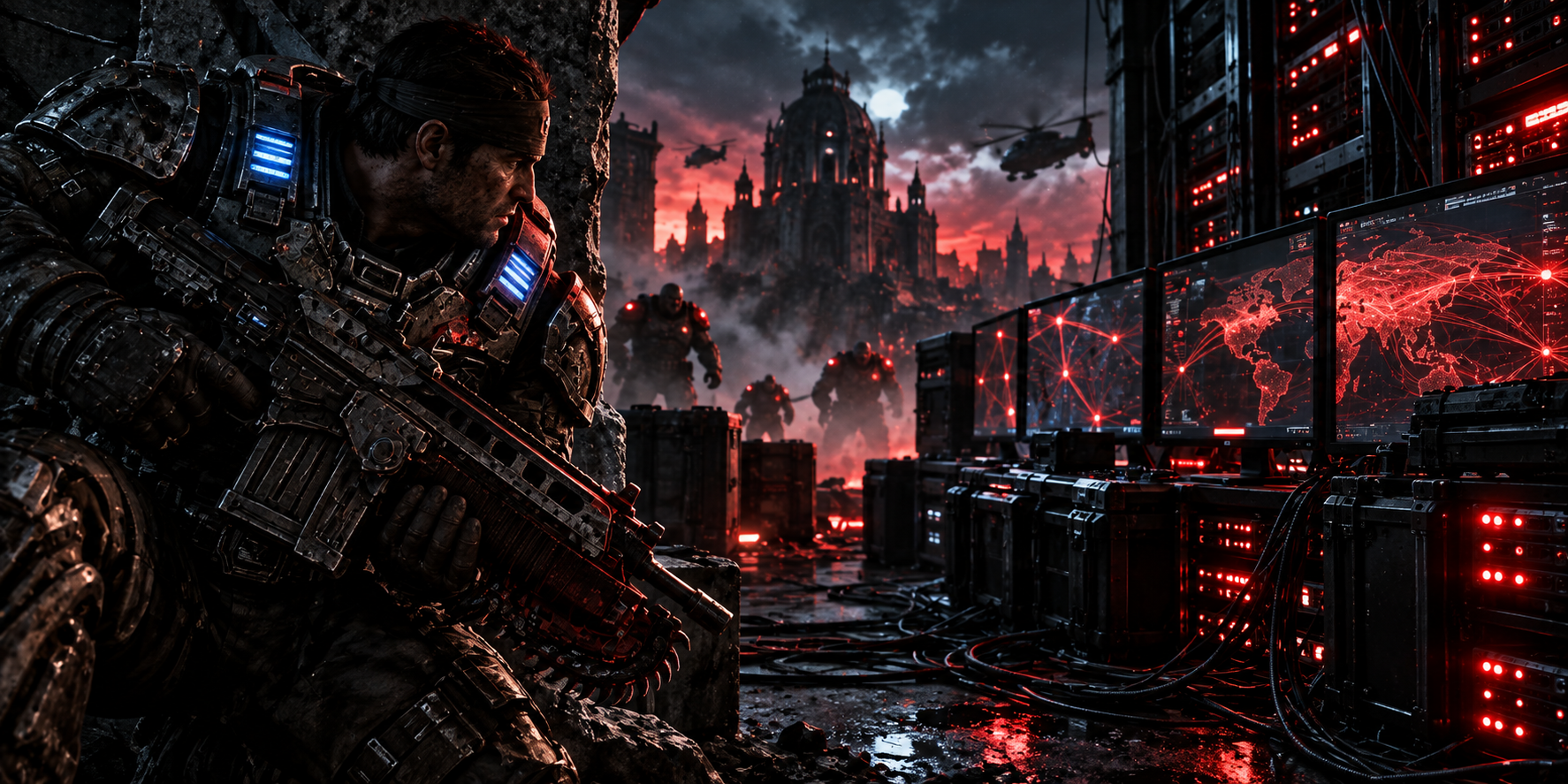
A cyberattack disrupted online services for Gears of War: E-Day during its launch week, leaving players struggling with login failures and dropped connections. The developer has confirmed the cause, but several questions remain unanswered.
The launch of Gears of War: E-Day has been disrupted by distributed denial-of-service (DDoS) attacks targeting the game’s online services. The Coalition confirmed the incident on October 12, 2026, after players reported intermittent disconnections, login problems and other service disruptions over the weekend. The studio said its teams were continuing to monitor and mitigate the activity.
For a major multiplayer release, connectivity problems can quickly become more than a technical inconvenience. Players may struggle to access online features, join matches or maintain stable connections. The incident also highlights how attacks against online infrastructure can affect an entire gaming community without necessarily compromising individual accounts.
What happened to Gears of War: E-Day?
Players began reporting problems accessing online services during the game’s first full weekend following its October 6 launch. Reports included difficulty connecting to multiplayer matches and connections dropping after players had entered a game. The Coalition subsequently attributed the disruptions to DDoS attacks aimed at its online services.
The developer has not publicly identified who was responsible, explained the motive behind the attack or disclosed the total number of affected players. It has also not reported that the incident resulted in the theft of player credentials or personal information. At this stage, the confirmed impact concerns service availability rather than a disclosed data breach.
That distinction matters. DDoS attacks and data breaches are different types of security incident, even though both can have serious consequences for gaming companies and their customers.
What is a DDoS attack?
A distributed denial-of-service attack attempts to overwhelm an online service with a large volume of traffic or requests. When the targeted infrastructure cannot handle the load, legitimate users may experience slow responses, failed logins, matchmaking problems or unexpected disconnections.
The attack can involve many devices sending traffic simultaneously, making it difficult for defenders to distinguish malicious activity from legitimate demand. Unlike an account takeover, a DDoS attack does not inherently require the attacker to gain access to a user’s password or private information.
In an online game, the effects can be particularly frustrating. Multiplayer experiences depend on reliable communication between players and the game’s infrastructure. If essential services become unavailable, even players with powerful gaming PCs, fast internet connections and otherwise stable systems may be unable to connect.
Why gaming services are attractive targets
Modern games rely on more than the game client installed on a player’s computer or console. Authentication, matchmaking, social features and other online components can depend on services operated by the developer or its infrastructure partners.
Disrupting those services can affect thousands of players without requiring attackers to compromise each player’s device individually. High-profile launches can also attract attention because large numbers of people are attempting to access the same services at the same time.
However, the timing of an attack does not establish its motivation. The Coalition has not publicly attributed this incident to a specific individual, group or campaign, so claims about who was behind it should be treated as unconfirmed.
Has player data been stolen?
There is currently no confirmed evidence in the cited reporting that the DDoS attack exposed Gears of War: E-Day player data. The developer’s public statement focused on intermittent disconnections, login issues and other service disruptions.
A service outage alone is not proof that attackers accessed account databases, passwords, payment information or personal records. Those claims would require separate evidence, such as a confirmed intrusion, a security advisory or a statement from the company identifying compromised information.
Players should nevertheless follow standard account-security practices. Use a unique password, enable multifactor authentication wherever available, and be cautious of messages claiming to offer compensation, exclusive rewards or special recovery links following the outage. Attackers sometimes exploit confusion around security incidents to trick users into revealing credentials.
How can developers defend against DDoS attacks?
Defending a large online game requires preparation before an attack begins. Common mitigation strategies include traffic filtering, rate limiting, distributed network capacity, specialized DDoS protection services and coordination with hosting and network providers.
Developers also need clear incident-response procedures. Monitoring can help teams identify abnormal traffic patterns, while status updates allow players to distinguish an infrastructure problem from an issue with their own devices or connections.
No single measure guarantees that every attack will be stopped immediately. The objective is to absorb or filter malicious traffic, preserve access for legitimate users and restore stable service as quickly as possible.
What happens next?
The Coalition said it was continuing to monitor and mitigate the attacks and would provide updates if there were significant changes. Subsequent reporting indicated that Xbox services had returned to normal, although the developer’s original statement did not provide a detailed account of the attack’s scale or duration.
The incident is a reminder that online gaming depends on infrastructure that players rarely see but rely on every time they sign in. As games become increasingly connected, service availability is an important part of the overall player experience—and a target that developers must be prepared to defend.
For now, the confirmed story is straightforward: Gears of War: E-Day suffered DDoS-related service disruptions, The Coalition acknowledged the attacks, and no public confirmation of stolen player data has emerged in the reporting cited here. Further conclusions about the attackers, their motives or any additional compromise would be premature.
H4CK.SE verdict: The incident is a useful example of how cyberattacks can disrupt modern gaming without necessarily constituting a data breach. The key questions are whether the developers can maintain stable service, what further details emerge, and whether the attack has any lasting impact on players.