









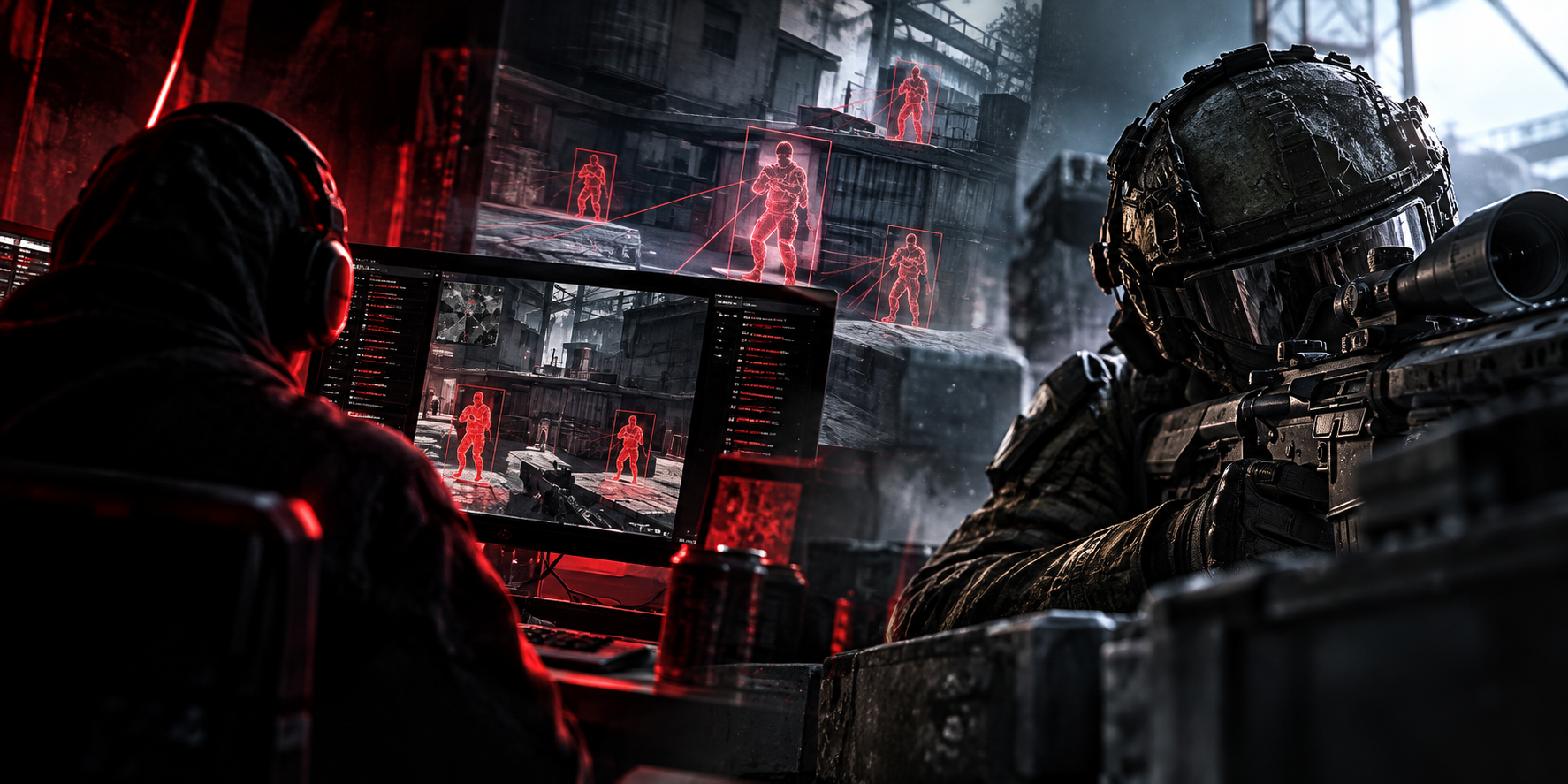
From simple aimbots to sophisticated systems designed to stay hidden, cheating has evolved alongside competitive gaming. But as anti-cheat technology becomes more advanced, are we finally entering an era where cheating is becoming harder than ever?
There is something uniquely frustrating about losing a competitive FPS match. You spend twenty minutes moving carefully through a map, hear footsteps, hold an angle and make what feels like the right decision. Then, suddenly, you’re eliminated by someone who appears to know exactly where you are. Maybe they were simply better. Maybe you made a mistake. Or maybe something else was happening.
Cheating has been part of PC gaming almost as long as competitive shooters themselves. What started as relatively simple software has developed into a sophisticated underground industry, constantly adapting to the technology designed to stop it. But the story of cheating isn’t simply about cheaters becoming better. It is also the story of developers building increasingly advanced systems to detect and remove them.
From simple cheats to an underground industry
The earliest forms of FPS cheating were often crude. Players experimented with console commands, modified game files and unofficial software, sometimes simply to have fun in environments where competition wasn’t important. But as online gaming became more competitive, the same technology began to have a much greater impact.
Aimbots, wallhacks and other forms of unfair assistance became increasingly common. Early anti-cheat systems were limited compared with what exists today, and developers often relied heavily on player reports and server-side checks. If somebody was obviously cheating, the community would usually notice first.
As competitive gaming grew, cheating became more than a hobby. It became a business.
Cheat developers began selling subscriptions, updates and support, creating an underground market where customers could pay for software specifically designed to give them an advantage. The more popular competitive games became, the more valuable that market became. And with money involved, cheat development became increasingly sophisticated.
The never-ending arms race
The relationship between cheat developers and game developers has become an ongoing technological arms race. When developers improve their detection methods, cheat creators look for ways around them. When a new technique is discovered, anti-cheat systems are updated again.
This is one reason modern anti-cheat is much more complicated than simply searching a computer for a suspicious program. Developers can analyze enormous amounts of information, including player behavior, game data, unusual accuracy, movement patterns and other signals that may indicate something isn’t right.
The goal isn’t always to catch someone immediately. Sometimes the system is looking for patterns that only become obvious after a player has played dozens or hundreds of matches.
That creates another problem: the better a cheat is at hiding, the harder it becomes to separate cheating from exceptional skill.
When cheating starts looking legitimate
The obvious cheater is relatively easy to identify. Someone making impossible movements or eliminating an entire team in seconds isn’t difficult for either players or automated systems to notice.
The much harder problem is the player who tries to look legitimate.
A player may deliberately miss shots, avoid suspicious behavior or simply use assistance in situations where it is difficult for other players to notice. This creates one of the biggest challenges facing modern anti-cheat systems: determining whether an unusually good player is genuinely skilled or receiving some form of assistance.
It’s also why accusations from the community need to be treated carefully. A professional-level player can look suspicious to an average player. A lucky shot can look like wallhacking. A perfect prediction can look impossible if you don’t understand what happened before the engagement.
Suspicion is not proof.
Why cheating damages more than a single match
The real damage caused by cheating goes far beyond one lost gunfight.
Competitive games depend heavily on trust. Players spend hundreds or thousands of hours learning maps, improving aim and developing strategies. If they begin to believe that some opponents aren’t following the same rules, the entire experience starts to feel pointless.
The questions begin to appear after every suspicious death:
Was that player cheating?
Did they know where I was?
Was that legitimate?
Eventually, some players stop asking those questions and simply stop playing.
That’s what makes cheating so dangerous. It doesn’t just remove individual players from a match. It can damage an entire community’s confidence in the game.
The problem became bigger with esports
The rise of esports made cheating even more serious. When competitive gaming involves prize money, sponsorships, rankings and professional careers, the incentive to gain an unfair advantage becomes considerably stronger.
A cheating scandal at a major tournament can damage the reputation of players, teams and organizers. It can also create questions about previous results and whether other competitors may have been involved.
The higher the stakes become, the more important competitive integrity becomes.
And developers aren’t only fighting traditional software anymore.
Hardware, automation and the next generation
Cheating has increasingly moved beyond the traditional idea of installing a suspicious program on a gaming PC. Hardware-based methods and external systems have created additional challenges for developers because the source of the unfair advantage may not be running directly inside the game environment.
Artificial intelligence could make the situation even more complicated.
The same advances in computer vision, automation and machine learning that can be used for legitimate purposes can potentially be abused to create new forms of assistance. That doesn’t mean every AI-related gaming tool is a cheat, but it does mean anti-cheat developers have another technological frontier to consider.
The future battle may therefore be less about identifying a known cheat and more about recognizing behavior that doesn’t make sense.
Are anti-cheat systems actually winning?
From the player’s perspective, it can sometimes feel like cheating is everywhere. Almost every major competitive FPS has communities sharing suspicious clips, discussing bans and complaining about unfair matches.
But there is another side to the story.
Anti-cheat technology has improved dramatically. Developers have access to far more data than they did years ago, and modern games can analyze player behavior at a scale that simply wasn’t possible during the early days of online gaming.
The objective isn’t necessarily to create a world where cheating becomes impossible. That is probably unrealistic.
The objective is to make cheating increasingly difficult, expensive and risky while protecting the overwhelming majority of legitimate players.
The future of competitive gaming
The fight between cheat developers and game developers probably isn’t going away. If anything, it will become more complicated as hardware, software and AI continue to evolve.
Cheat developers will search for new weaknesses. Anti-cheat teams will develop new detection methods. Players will continue reporting suspicious behavior, and developers will continue trying to determine where legitimate skill ends and unfair assistance begins.
But the fundamental principle hasn’t changed.
Players don’t expect to win every match. They expect to lose to someone with better aim, better positioning or better decision-making. That’s part of competitive gaming.
What they don’t expect is to lose because another player decided the rules didn’t apply to them.
The real battle
Cheating has survived every major generation of FPS gaming. It survived the early PC shooters, the rise of online multiplayer, the growth of esports and increasingly sophisticated anti-cheat technology.
It will probably survive whatever comes next.
But that doesn’t mean developers are losing.
The real goal isn’t to eliminate every cheater forever. It’s to protect the integrity of competitive gaming and make sure legitimate players can compete on equal terms.
Because when the match starts, everyone should have the same opportunity.
You can lose because someone was better. You can lose because you made a mistake.
But you shouldn’t lose because someone cheated.
And that is the battle that FPS games will probably be fighting for as long as competitive gaming exists.