











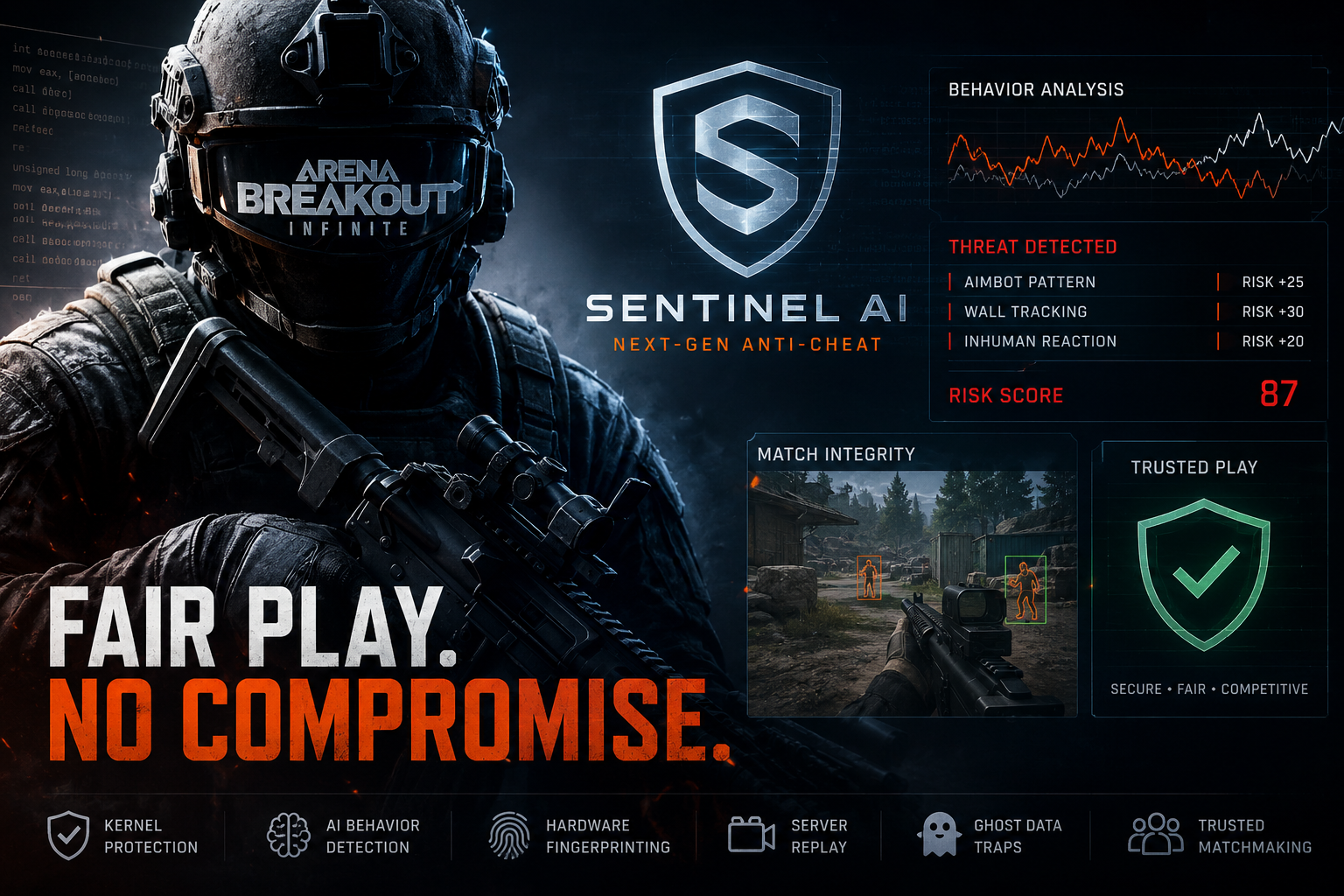
Cheating in competitive shooters has become one of the biggest threats to online gaming. From wallhacks and soft aim-assist tools to DMA hardware exploits and AI-powered cheats, developers are now fighting a much more advanced enemy than ever before.
For extraction shooters like Arena Breakout: Infinite, the problem becomes even more serious. Losing gear, progression, and valuable loot to cheaters can instantly ruin the experience for legitimate players.
So what would a truly modern anti-cheat system look like?
Here’s a professional concept for a next-generation anti-cheat framework designed specifically for competitive extraction shooters.
Sentinel AI – Multi-Layer Anti-Cheat Protection
Instead of relying only on traditional cheat signatures, Sentinel AI combines behavioral analysis, server-side monitoring, hardware verification, and artificial intelligence to detect suspicious players more accurately.
The goal is simple:
- Detect cheaters faster
- Reduce false bans
- Protect legitimate players
- Make cheating significantly harder
Kernel-Level Protection
At the core of the system is a lightweight kernel-level anti-cheat driver designed to launch before the game starts.
This layer monitors:
- Memory injections
- Unauthorized overlays
- Driver manipulation
- DMA hardware abuse
- Macro tools
- Third-party cheat loaders
Unlike older systems that instantly ban users after detection, Sentinel AI uses a hidden risk-score system.
Example:
- Cheat overlay detected = +30 risk
- Impossible recoil control = +25
- Suspicious input behavior = +15
When the risk score reaches a certain threshold, the account is flagged for deeper server-side analysis.
This delayed approach prevents cheat developers from instantly discovering how the detection happened.
AI Behavioral Detection
This is where modern anti-cheat systems need to evolve.
Cheat software can hide itself from traditional scans, but it cannot easily hide unnatural gameplay behavior.
Sentinel AI continuously analyzes:
- Mouse movement patterns
- Recoil compensation
- Reaction times
- Crosshair placement
- Tracking precision
- Snap targeting
- Enemy awareness
The system compares player data against:
- Legitimate player datasets
- Professional player behavior
- Known cheat behavior patterns
Detecting Aimbots
Human aim is naturally imperfect.
Even highly skilled players show:
- Small corrections
- Slight over-aim
- Micro jitter
- Inconsistent tracking speed
Aimbots often produce:
- Perfect smoothness
- Linear tracking
- Instant snapping
- Inhuman consistency
The AI looks for impossible accuracy patterns over time instead of relying on single moments.
This makes “soft cheats” far easier to detect.
Detecting Wallhacks and ESP
Wallhack users often reveal themselves through behavior rather than aim.
Sentinel AI tracks:
- Pre-aiming hidden enemies
- Tracking targets through walls
- Unnatural pathing toward rare loot
- Suspicious awareness without audio cues
If a player repeatedly follows enemy movement through terrain without legitimate information, the suspicion level rises dramatically.
Trusted Matchmaking System
One of the smartest features is a hidden trust-factor system.
Players receive trust ratings based on:
- Account age
- Previous bans
- Report history
- TPM/Secure Boot status
- Hardware integrity
- Verified phone numbers
- Consistent gameplay history
Trusted players are matched together more frequently, while suspicious accounts are silently grouped into lower-trust lobbies.
This protects legitimate players without publicly exposing detection methods.
Advanced Hardware Fingerprinting
Simple HWID bans are no longer enough.
Modern cheat providers already sell spoofers capable of bypassing standard hardware bans.
Sentinel AI would instead create a deeper hardware identity using:
- TPM modules
- BIOS identifiers
- SSD serials
- CPU characteristics
- Peripheral timing signatures
Spoofing becomes far more difficult when multiple hardware layers are verified together.
Server-Side Replay Verification
Every engagement is temporarily stored server-side, including:
- Aim vectors
- Visibility checks
- Audio information
- Player movement
- Input timing
When reports spike or suspicious behavior is detected, the system automatically reviews the encounter using AI-assisted replay analysis.
Edge cases can then be escalated to human moderators for final review.
This significantly lowers the risk of false positives.
Secure Competitive Queue
For ranked gameplay, stricter security requirements could be enforced:
- TPM enabled
- Secure Boot active
- Verified drivers
- Phone verification
- Clean operating system environment
This creates a highly trusted competitive environment for serious players.
Ghost Data – Catching ESP Users
One of the most advanced concepts is the use of invisible “ghost entities.”
The server secretly places fake:
- Loot containers
- Audio cues
- Invisible player signatures
Legitimate players never see these objects.
However, ESP users often react to them by:
- Looking directly at them
- Moving toward them
- Tracking them through walls
This creates an incredibly strong detection signal with very low false-positive risk.
Delayed Ban Waves
Immediate bans often help cheat developers improve their software faster.
Instead, Sentinel AI would rely heavily on delayed ban waves.
Thousands of flagged accounts could be removed simultaneously, making it much harder for cheat creators to understand what triggered the detection.
This strategy has proven highly effective in modern competitive games.
Transparency Builds Trust
Players lose confidence when anti-cheat systems operate in silence.
A monthly transparency report could include:
- Total bans issued
- Cheat types detected
- Security improvements
- False-positive statistics
Keeping the community informed helps restore trust in competitive integrity. I know abi is already doing it, but there is ways to make it even better.
The Future of Competitive Gaming
Cheating technology is evolving rapidly.
Traditional anti-cheat systems based only on signatures and scans are no longer enough against modern DMA devices, AI-assisted cheats, and advanced spoofing tools.
The future belongs to systems that understand player behavior rather than simply detecting software.
Because while cheats can hide code…
They cannot easily hide inhuman behavior.